Private Sector · Infrastructure · Service Direction
Digital strategy for a specialist distributor still running on paper
Overview
A century-old infrastructure supplier — the largest privately owned in its field in New Zealand — faced growing pressure to digitise. The question wasn't whether to invest, but where to start.
The process used to develop the digital ambition and roadmap — moving from current-state problems through value mapping, opportunity reframing, and sequencing to define a prioritised digital direction.
My role
Service Designer — I led customer and business discovery through interviews across sales, warehousing, and customer service, and synthesised insights to support leadership decision-making on digital priorities and investment sequencing.
I worked closely with the engagement team (director, partner, and manager) to shape the evidence and framing used in senior leadership discussions.
What needed deciding
The challenge
A specialist distributor with 200+ employees sourcing from 200+ global suppliers was facing rising pressure from post-COVID disruption, internal consolidation, and digitally native competitors offering greater transparency and self-service.
The fragmentation was tangible — sales teams quoted different lead times for the same products while customer service couldn't access real-time inventory. Without a shared view of where digital investment would create most value, decisions risked being driven by trends rather than operational need.
The focus was to clarify which problems to address digitally first, grounding investment in service reliability and constraint removal rather than internal preferences or market pressure.
How might we decide which problems are worth solving digitally first, and which should wait, given the operational constraints and limited change capacity?
Who this affected
B2B customers managing tight project timelines relied on accurate delivery commitments to plan downstream work. For them, uncertainty wasn't just inconvenient. It created planning risk that damaged the supplier relationship over time, especially in a post-COVID environment where supply chains were already stretched.
Frontline staff across sales, warehousing, and customer service were caught between customer expectations and unreliable internal data. Without accurate inventory visibility, confident commitments were impossible regardless of channel or digital investment.
How direction was shaped
One grounding insight
An early insight from both customer and frontline research was that reliable commitments mattered more than digital touchpoints. Customers were willing to wait for materials, but uncertainty about delivery timing created planning challenges and eroded trust in the supplier relationship—especially post-COVID when supply chains were already stretched.
In some cases, lead-time commitments varied by weeks or months due to upstream factory and shipping delays. Frontline teams lacked reliable inventory data, making confident delivery commitments impossible regardless of channel. This reframed the digital ambition: the problem wasn't features, it was foundational reliability.

Synthesis boards consolidating findings from customer interviews and surveys, used to identify recurring patterns across customer and frontline perspectives before shaping prioritisation recommendations.
Approach
Rather than starting with systems or solutions, the work examined customer experience and operational reality together — understanding where breakdowns in service flow affected reliability, cost, and trust across sales, warehousing, customer service, and supply chain.
The intent was not to design a future system, but to give leadership a shared, evidence-based view of where digital investment would reduce constraint rather than add complexity.
Key activities
Conducted interviews, surveys, and ethnographic observation across 50+ employees and customers spanning multiple facilities, surfacing gaps between official processes and actual work behaviours
Researched best-in-class competitors to identify where digital investment had created genuine customer value versus visible but shallow change
Synthesised findings into prioritisation-ready problem statements
Designed and facilitated leadership working sessions to assess impact, effort, and dependency risk across digital investment options
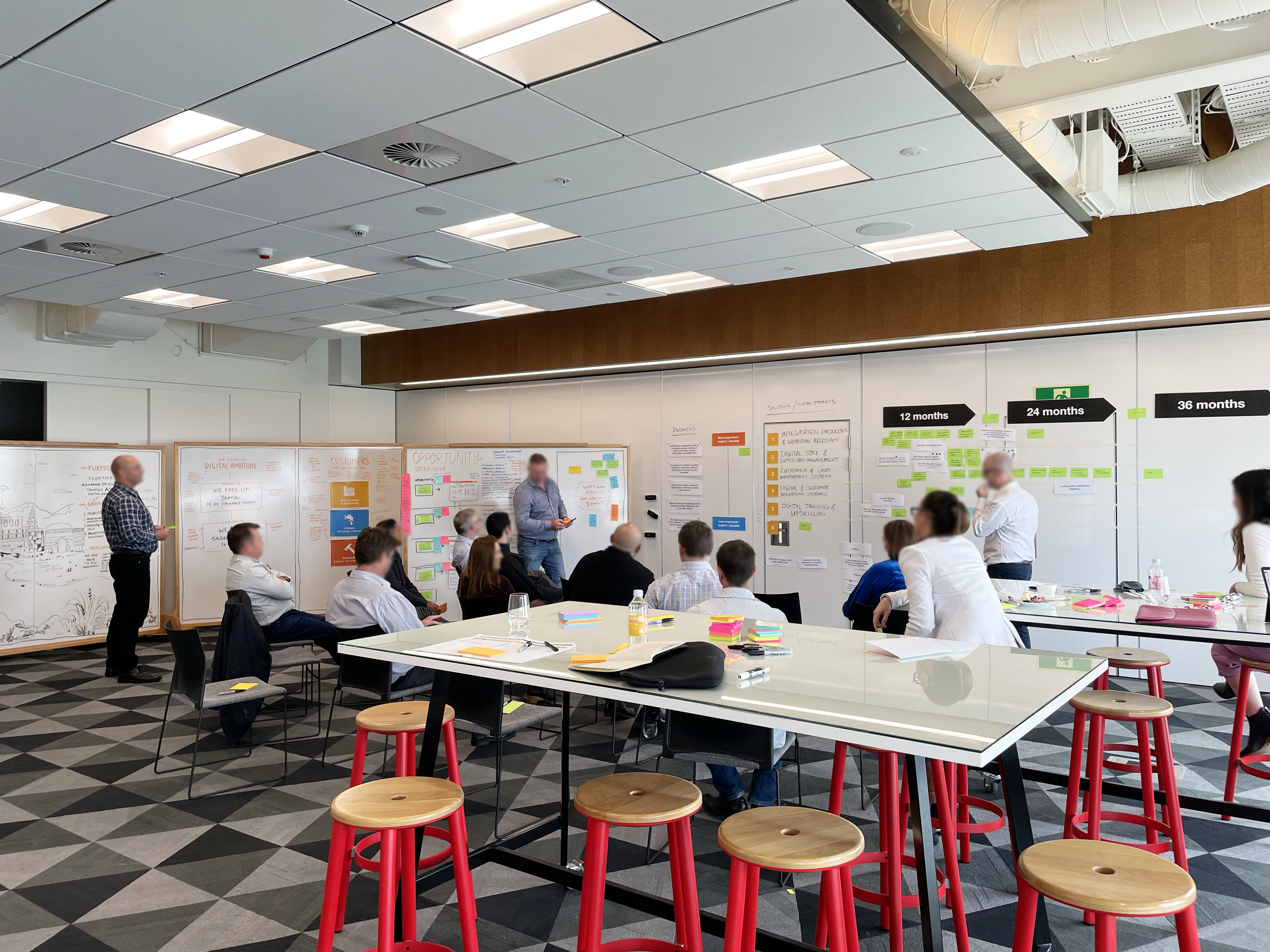
A leadership working session exploring digital investment priorities across a 36-month horizon.
Contributions to key decisions
Framed digital opportunities in terms of combined customer impact and operational effort
Made visible where customer-facing issues were symptoms of deeper data, inventory, or process constraints
Highlighted dependencies that would limit value if initiatives were addressed out of order
Provided evidence to deprioritise initiatives that would create visible change without improving reliability
Why these decisions mattered
Without grounding prioritisation in operational reality, digital investment risked accelerating fragmentation rather than improving performance. Investment order needed to remove constraints first, or customer-facing change would expose underlying weaknesses rather than build trust.
This work helped leadership make explicit trade-offs, accepting slower visible change in exchange for more reliable customer commitments and reduced rework.
Outcomes and implications
Key deliverables
Discovery synthesis consolidating customer pain points and linking them to underlying operational and data constraints
Prioritised digital roadmap sequencing initiatives by dependencies, customer impact, and change capacity
Decision-focused synthesis supporting leadership forums to assess trade-offs and agree where to start and what could wait.
Outcomes and impact
The organisation was positioned to deliver more reliable commitments to B2B customers, reducing the planning uncertainty that had been eroding trust in the supplier relationship
Frontline staff could stand behind their commitments to customers, rather than hedging around data they couldn't rely on
The organisation avoided investing in visible digital features that would have exposed underlying reliability problems rather than solved them
Digital investment was sequenced to build capability that would last, rather than rushing visible change at the cost of long-term trust
Key learning
Under market pressure, digital transformation struggles when leaders prioritise visible progress over reliability. Using discovery to shape investment order, not just identify opportunities, was critical to protecting customer trust while the organisation adapted at a sustainable pace.