Public Sector · Science Research · Futures and Speculative Design
Futures design inside a science research organisation
Overview
Science research organisations are under increasing pressure to demonstrate real-world impact, but the processes used to set research direction rarely surface whether they're pointing toward the right futures. This engagement explored how design could help.
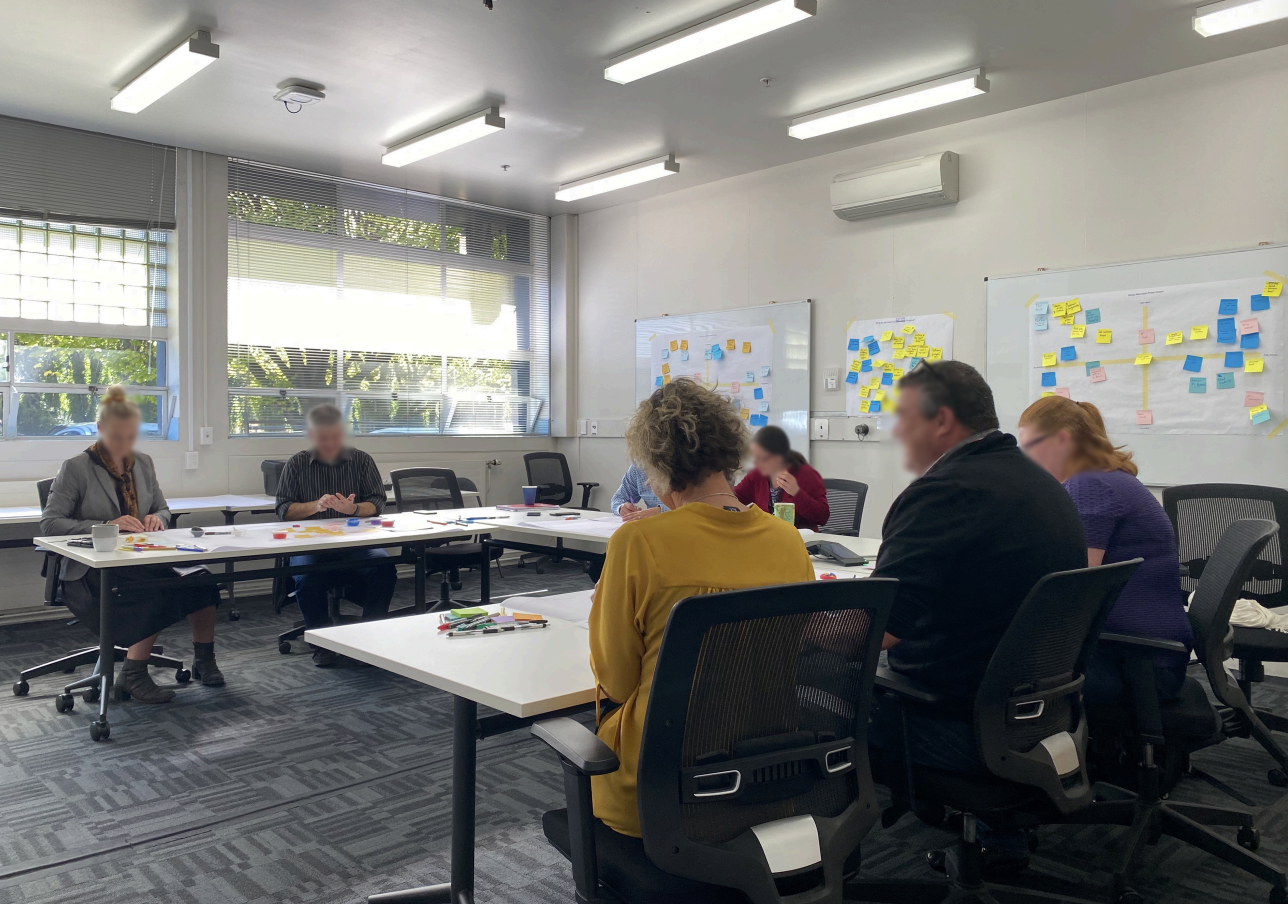
Speculative design workshop in progress at AgResearch — scientists and researchers working across disciplines to surface mental models and collectively imagine desirable futures for the alternative proteins programme.
My role
Designer and Researcher — Embedded within AgResearch's sustainability transitions programme over a year-long industry-funded Master of Design engagement, I designed and facilitated a speculative design process to help science researchers think beyond their current frame and direct research towards more desirable futures.
This case study focuses on the main engagement within the alternative proteins programme, building on an earlier internship where I facilitated three workshops with 35 participants and developed an infographic resource to create shared understanding of transition and transformation across the organisation.
What needed deciding
The challenge
AgResearch was developing strategy to respond to the global rise of alternative proteins, including plant-based, cultured, and insect-derived food sources reshaping consumer demand and challenging traditional agricultural models.
Strategy development was shaped by existing mental models that were rarely made explicit or questioned, risking a strategy that reflected current thinking rather than the futures the organisation was trying to help create. A further tension was disciplinary. Scientists are trained to work with evidence and prediction, while the work required imagining desirable futures, a mode of thinking design was better placed to enable.
The alternative proteins programme was identified as the right context: early-stage enough that speculative methods could genuinely shape direction rather than validate decisions already made.
How might design shift how scientists think and work, so that the research they pursue leads towards futures that are desirable rather than just probable?
Who this affected
For science researchers, the process asked something genuinely uncomfortable. Professional identity built on evidence and defensible conclusions meant prototyping with modelling clay and world-building twenty years out sat outside every convention of good science. That friction was not a problem to solve; it was the point. One participant described it as "getting my head out of current constraints" — exactly the shift the process was designed to create.
For the organisation, alternative proteins was not just a market opportunity but a values question. Deciding what role AgResearch should play required clarity on what kind of future it wanted to help create, not just what research it was capable of doing.
How direction was shaped
A grounding insight
Grounded in sustainability transitions theory and socio-technical systems thinking, a review of 50+ sources revealed a structural problem. The most powerful leverage points in any system are the mindsets and paradigms from which it operates — and those are exactly what science research's deductive mode tends to leave unquestioned. If strategy was to orient towards transformation rather than incremental change, the process needed to actively challenge the assumptions underpinning it, not just gather evidence within them.
Approach
Drawing on the Ethnographic Experiential Futures cycle and the Experiential Futures Ladder, I designed a three-workshop speculative design process that moved participants from surfacing existing mental models through to prototyping radical future ideas and world-building around them.
Rather than presenting futures to researchers, the process asked them to construct futures themselves, through drawing, modelling clay, writing, and structured speculation. A pilot workshop and structured retrospective after each session informed iterative refinements, ensuring the process improved across the three main workshops while maintaining consistency for comparison.
Key activities
Designed and facilitated a pilot and three speculative design workshops across three campuses, with 27 participants ranging from PhD students to senior scientists and leadership
Developed and iterated workshop activities including word association, visualisation, opportunity matrix, vision ladder, and future canvas to surface mental models and generate radical future ideas
Synthesised twelve prototype ideas into four illustrated future scenarios, premiumise, feed the masses, post-food, and new earth, spanning food, agriculture, and entirely new domains
Conducted 15 interviews with scientists and design practitioners using systematic thematic coding in NVivo, and facilitated a scenario test workshop with 13 participants to test scenarios as strategy tools
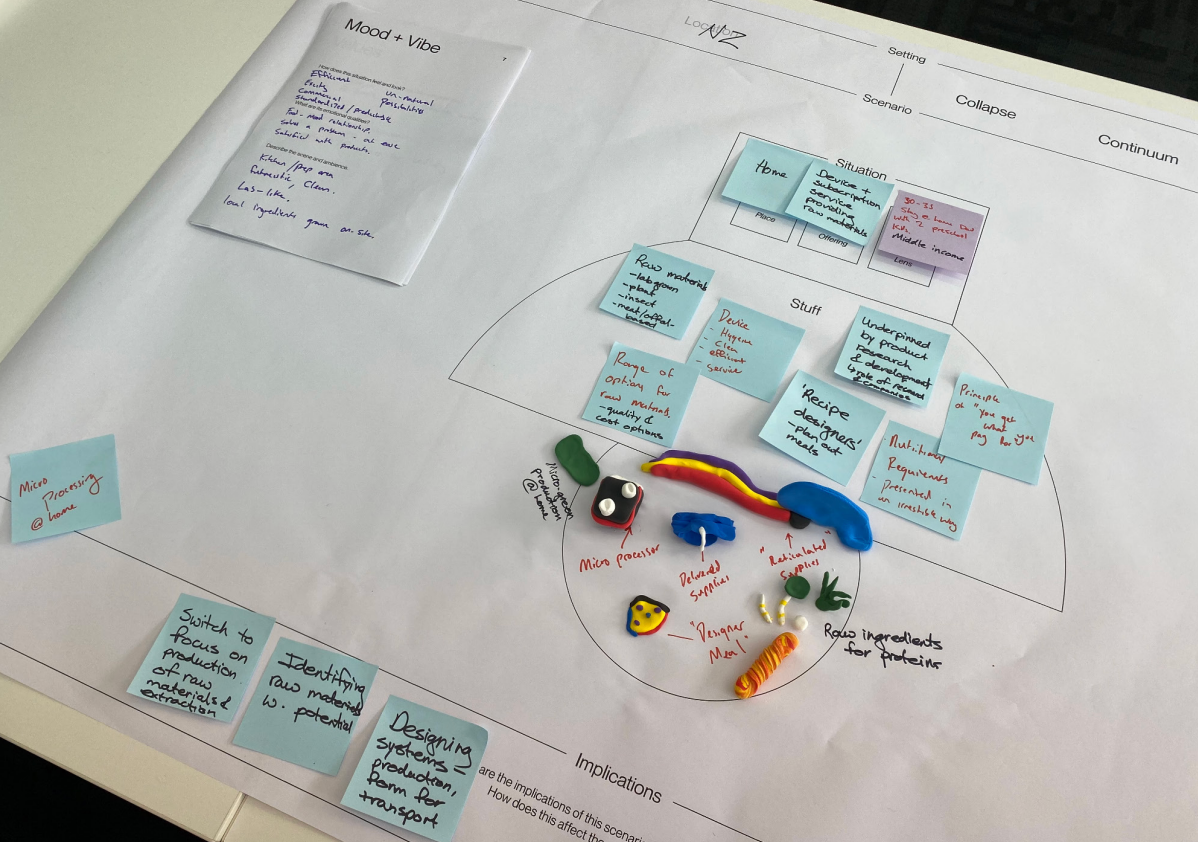
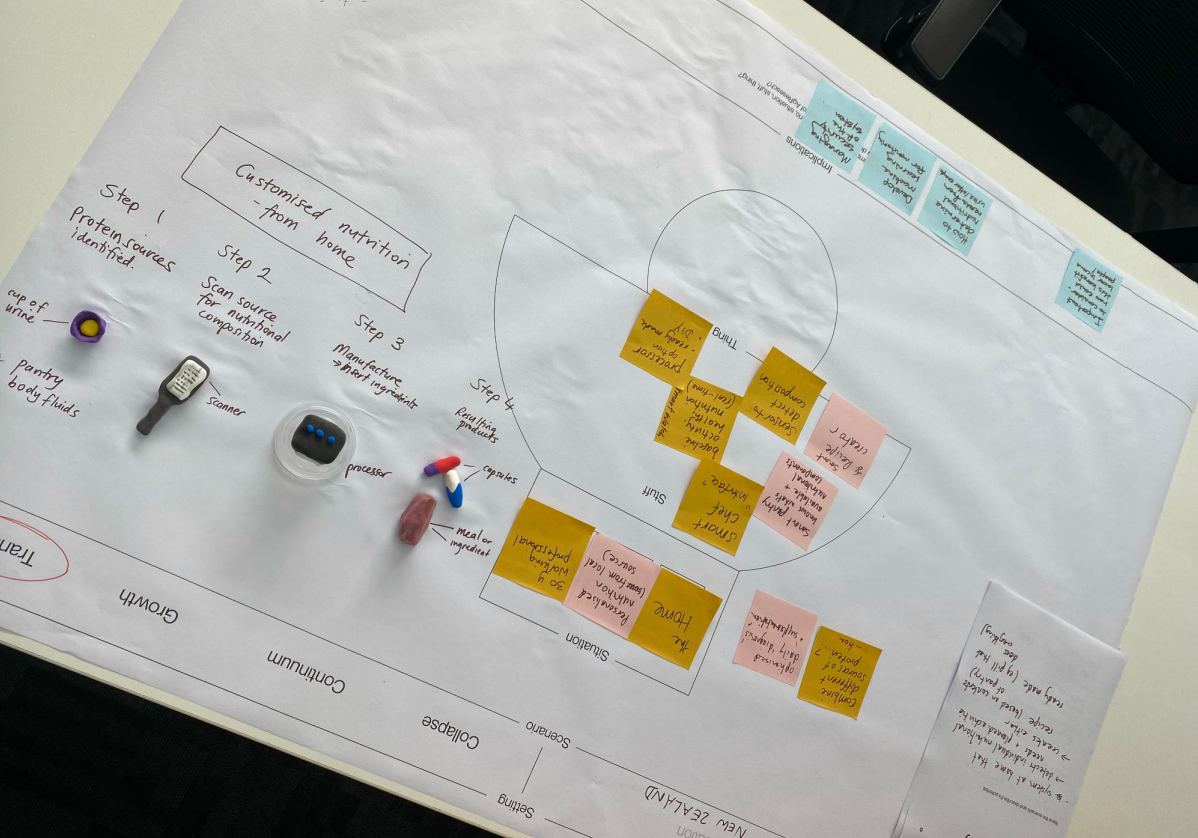
Participants world-building on the future canvas during speculative design workshops — using modelling clay, post-it notes, and writing to prototype radical alternative protein ideas and imagine the worlds they could create.
What changed
The process surfaced what conventional strategy had not — that assumptions about alternative proteins and AgResearch's role were more varied, more contested, and more constraining than anyone had made explicit.
By asking researchers to prototype and world-build rather than analyse and report, the workshops revealed latent ideas that conventional approaches left untouched. In a cross-campus strategy session, participants who had spent earlier workshops debating what alternative proteins currently were shifted to asking what could become possible if this were normal. That shift, from describing the present to collectively imagining a transformed future, was the most honest measure of what the process was trying to create.
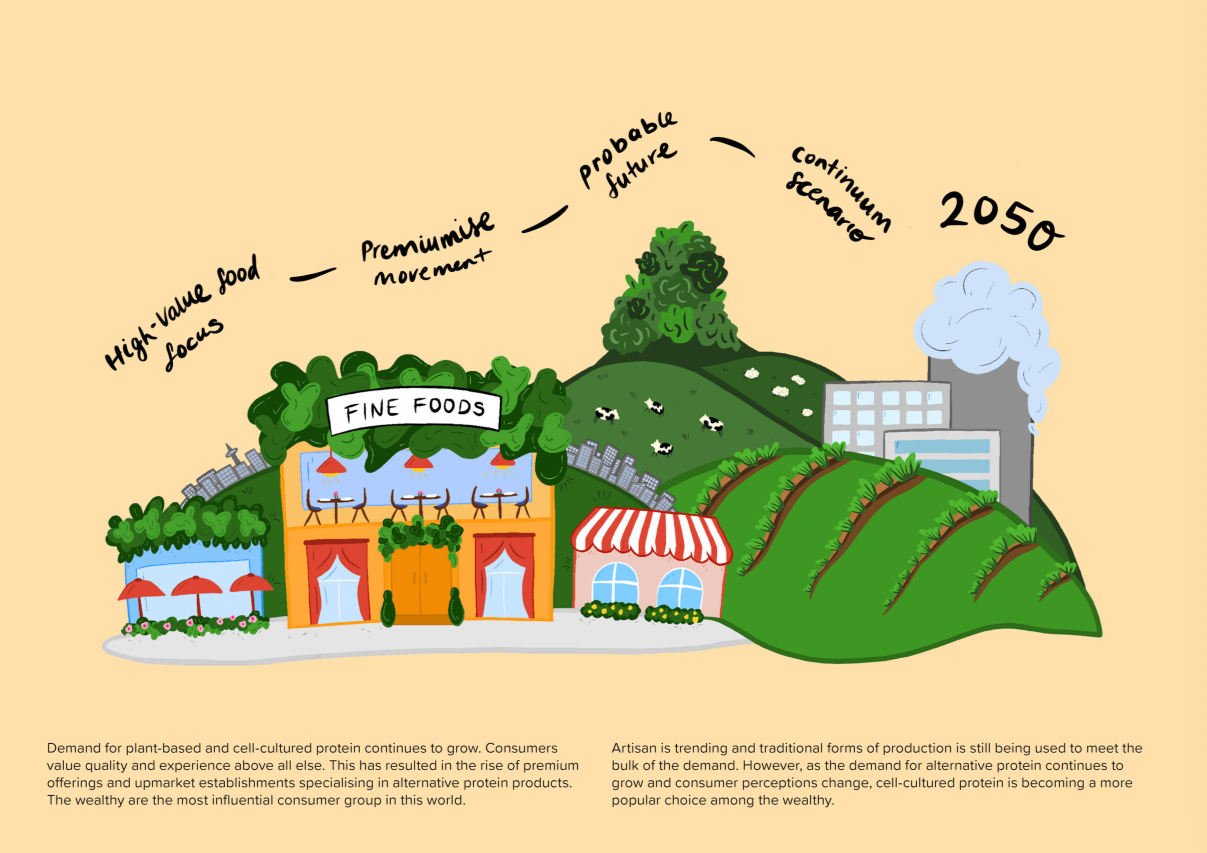
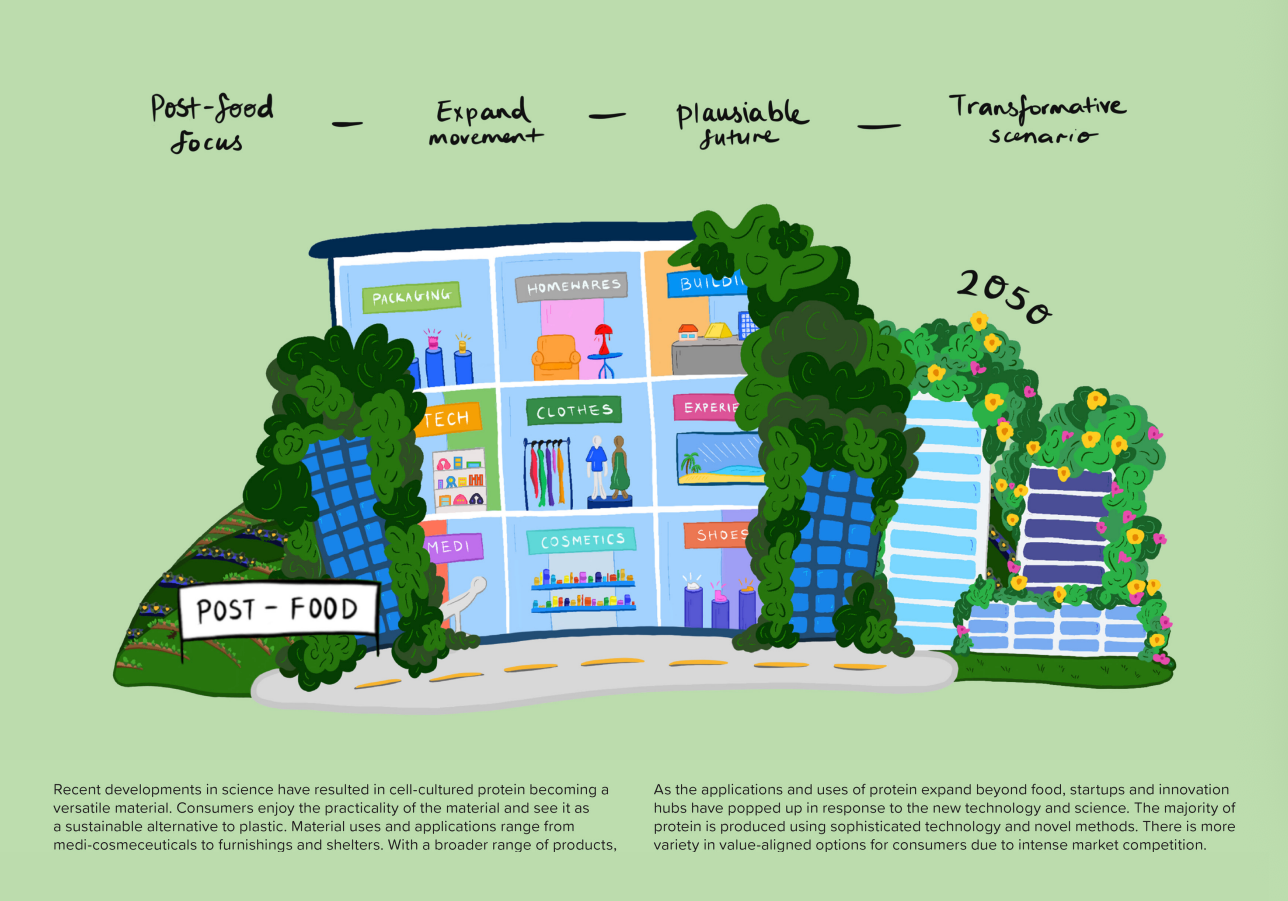
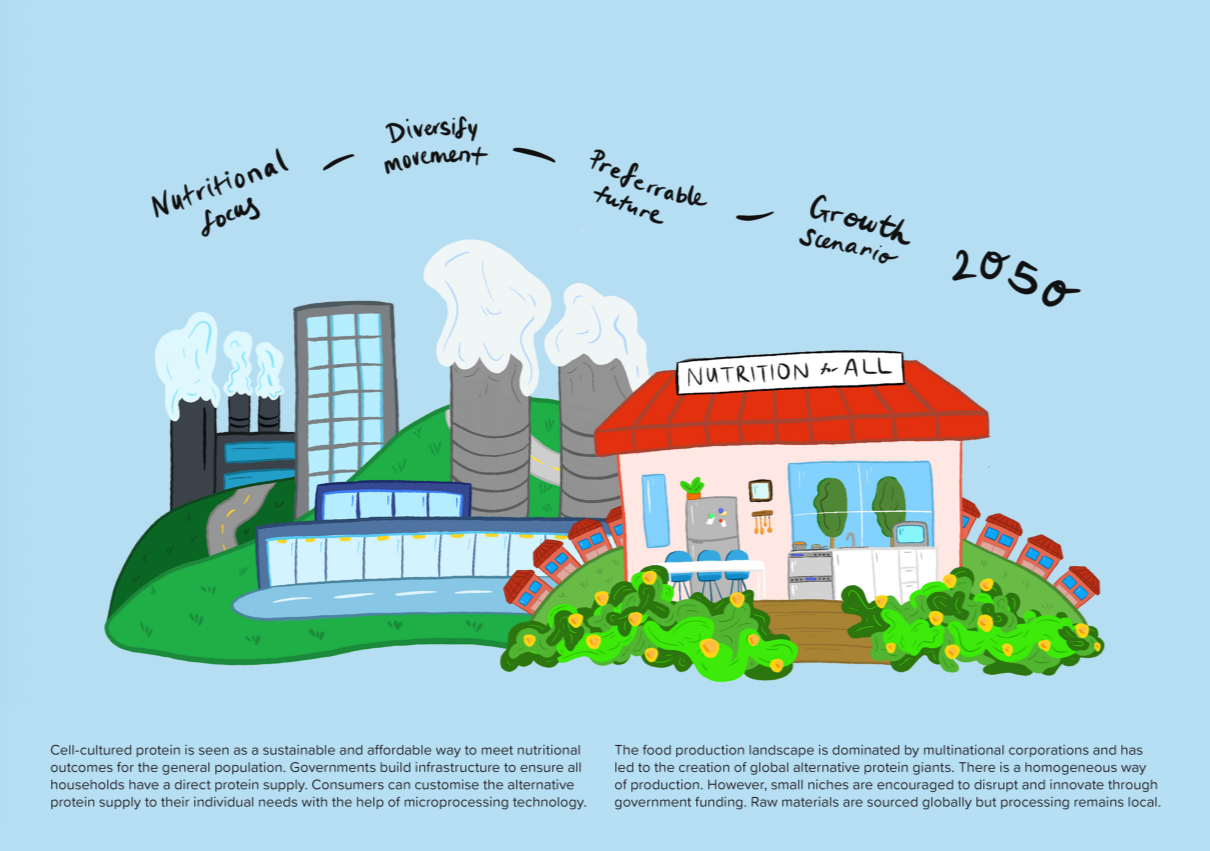
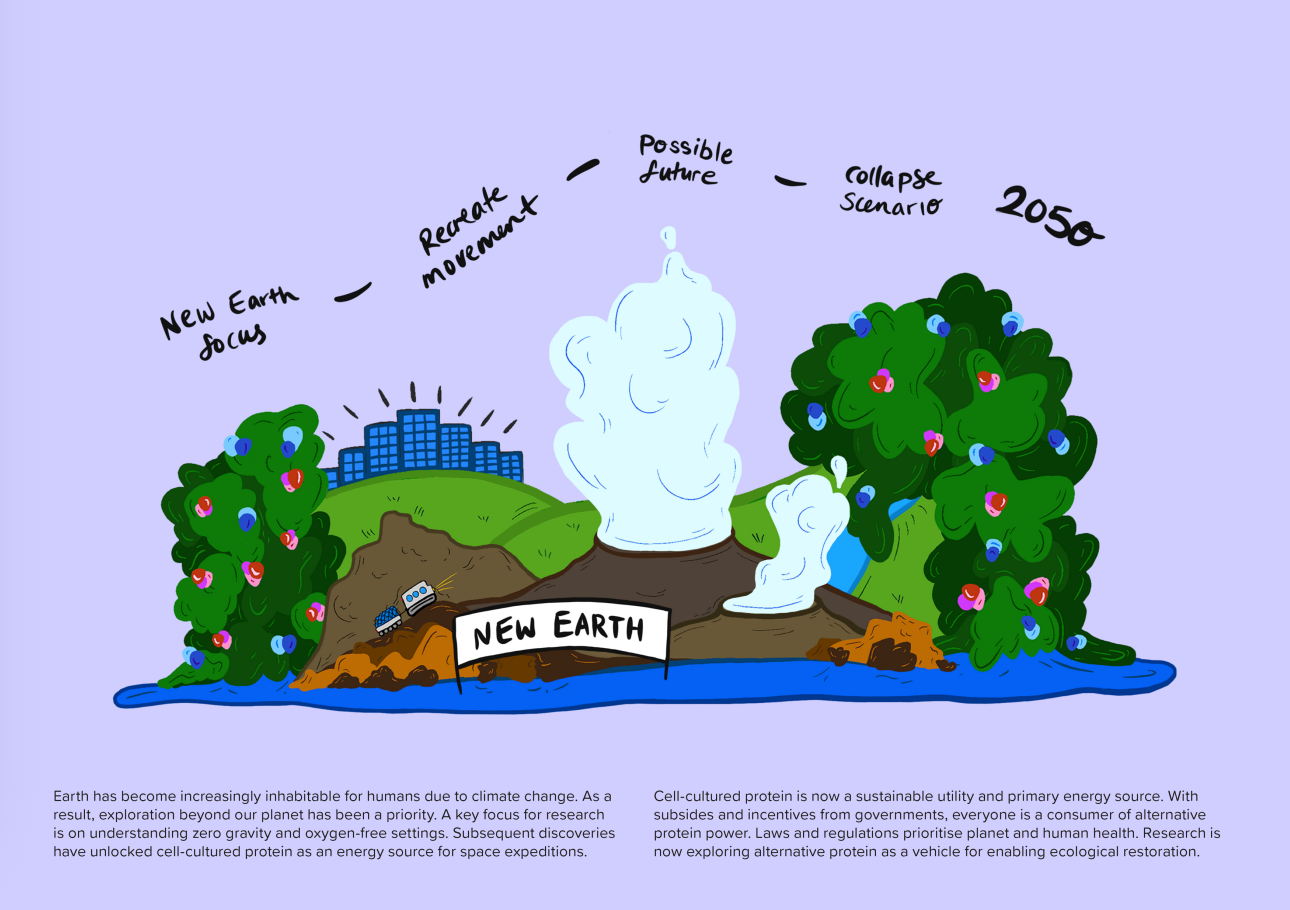
Four illustrated future scenarios for 2050 — premiumise, feed the masses, post-food, and new earth — synthesised from workshop participants' ideas and used as strategy development tools across the programme.
Why this matters
Science research organisations make long-term investment decisions that shape what futures become possible, and strategy that cannot question its own assumptions tends to reinforce the current frame rather than open new ones.
Outcomes and implications
Deliverables
Four illustrated future scenarios, premiumise, feed the masses, post-food, and new earth, synthesised from 27 workshop participants' ideas and used as strategy development tools
Prototype speculative design toolkit including process framework, ideation matrix, future canvas, framing tool, and retrospective template
Published Master of Design thesis integrating interview insights from 15 scientists and design practitioners, documenting the full speculative design process, findings, and recommendations for AgResearch — published through Toi Aria, Massey University [full thesis]
Outcomes and impact
40 science researchers and strategists across three campuses shifted from prediction-based to imagination-based strategic discussion, generating twelve distinct future ideas spanning food, post-food, and new earth themes
Scenarios and toolkit adopted beyond the original engagement, embedding design capability within the organisation rather than treating it as a one-off intervention
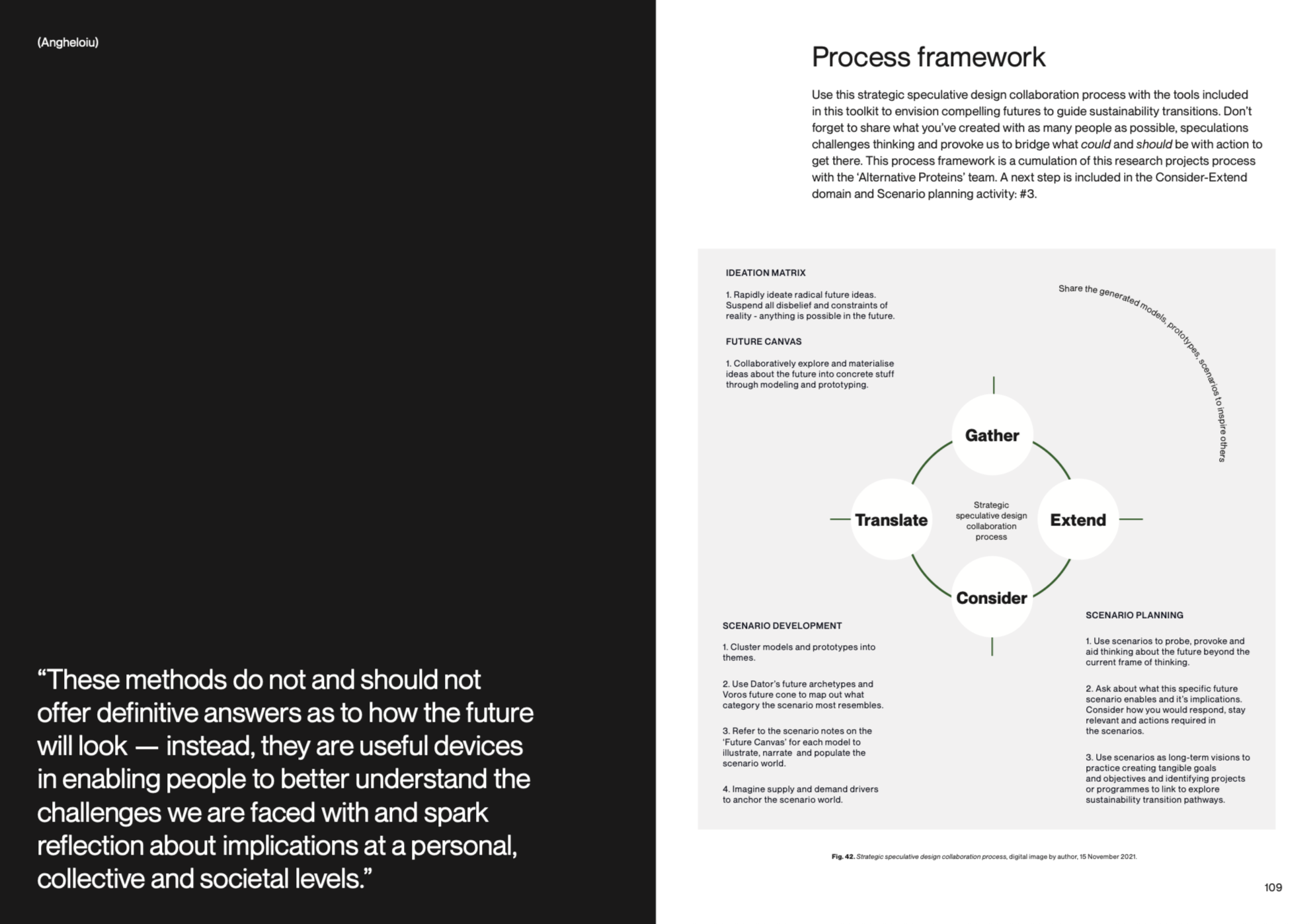
Strategic speculative design collaboration process — from ideation and world-building through to scenario development and strategic planning, packaged as a reusable toolkit for AgResearch.
Key learning
The most significant challenge was not making futures tangible but creating conditions where scientists felt safe enough to speculate. Designing workshops that respected disciplinary identity while genuinely asking researchers to work beyond it required as much facilitation intelligence as design skill. In unfamiliar contexts, process design is as important as the outputs it produces.