Private Sector · Regulated Banking · Advisory Services
Designing compliant customer conversations across a retail banking platform
Overview
A large bank needed to standardise advisory workflows and regulatory capture across four banking segments before build, reducing friction, risk, and platform complexity across 1M+ customer interactions delivered through an enterprise CRM platform.
My role
Service Designer — Working with an offshore UX Lead as one of two designers across a 6-month engagement, I contributed post-discovery workflow design, usability testing, and validation. I shaped service-level logic, conversation frameworks, and design inputs used by business, compliance, and technical teams to define build-ready requirements within an enterprise CRM platform. I worked closely with product, operations, and senior business stakeholders to align on service rules, delivery feasibility, and regulatory risk.
This case study focuses on one of two projects I contributed to within the programme. My later work progressed customer and staff journey maps through to service blueprints for all four banking segments, using service scenarios to surface pain points, identify opportunities, and connect technical release features to real service gaps within a live digital transformation programme.
What needed deciding
The challenge
The bank served 1.2 million customers across retail, wealth, institutional, and business banking under strict regulatory requirements. Advisory processes had evolved independently across segments, creating three tensions: compliance versus usability, consistency versus variation, and scalability versus system complexity.
Advisers were manually checking multiple systems and creating informal notes — reducing time with customers and creating risk around regulatory capture. Different segments required different levels of complexity but had to meet the same standards. And multiple CRM configurations risked inflating long-term maintenance costs across a platform intended to serve the entire bank.
The focus was a single framework that supported varied advisory needs without fragmenting the platform, increasing compliance risk, or requiring unrealistic behaviour change from advisers.
How might we embed regulatory compliance into advisory conversations without disrupting the trust and rapport that make those conversations valuable?
Who this affects
For customers, sensitive financial conversations required genuine listening and relationship, not transaction processing. Research showed people valued feeling understood over administrative efficiency, and visible system use during financial conversations could undermine trust.
For advisers across 1.2 million customer relationships, screens were used sparingly during face-to-face meetings. Key information was captured through notes and entered later. Designing workflows that assumed continuous system use would have required a significant and unrealistic shift in adviser behaviour.
For compliance and technical teams, inconsistent regulatory capture across four segments created gaps in the audit trail required for regulatory reporting — each segment handling data differently made it difficult to evidence compliance at scale, adding platform complexity and delivery risk that needed resolving before build.
How direction was shaped
The grounding insight
Early current-state validation with business SMEs revealed a fundamental tension: advisers prioritised relationship quality over system interaction during face-to-face meetings. Rather than treating regulation as an administrative layer, the work reframed compliance as conversation guidance, embedding required prompts directly into advisory flows so advisers could stay focused on customers while remaining compliant.
This reframed the problem from how to capture everything in the moment to how to support accurate, compliant capture without forcing interaction patterns that undermined trust.
Approach
Early analysis surfaced three design strategies: compliance-first, segment-specific, or embedded design. Embedded design was recommended as the only approach that improved usability while maintaining consistency and scalability across segments.
Working within an agreed programme direction alongside the UX Lead, regulatory requirements, current-state advisory practices, and CRM platform constraints were brought together into service-level workflow concepts and conversation frameworks. The emphasis was on making regulatory and information-capture logic explicit so teams could reason about consistency, variation, and behaviour change before decisions were locked into build.
Four baseline scenarios were defined — retail, business, private banking, and institutional — each tailored to its advisory complexity while sharing common regulatory foundations. This modular structure allowed flexibility without duplicating effort or logic.
Business process and data flow work surfaced how customer data moved across fragmented systems, informing standardised workflow design that captured consistent regulatory and operational data across all four segments.
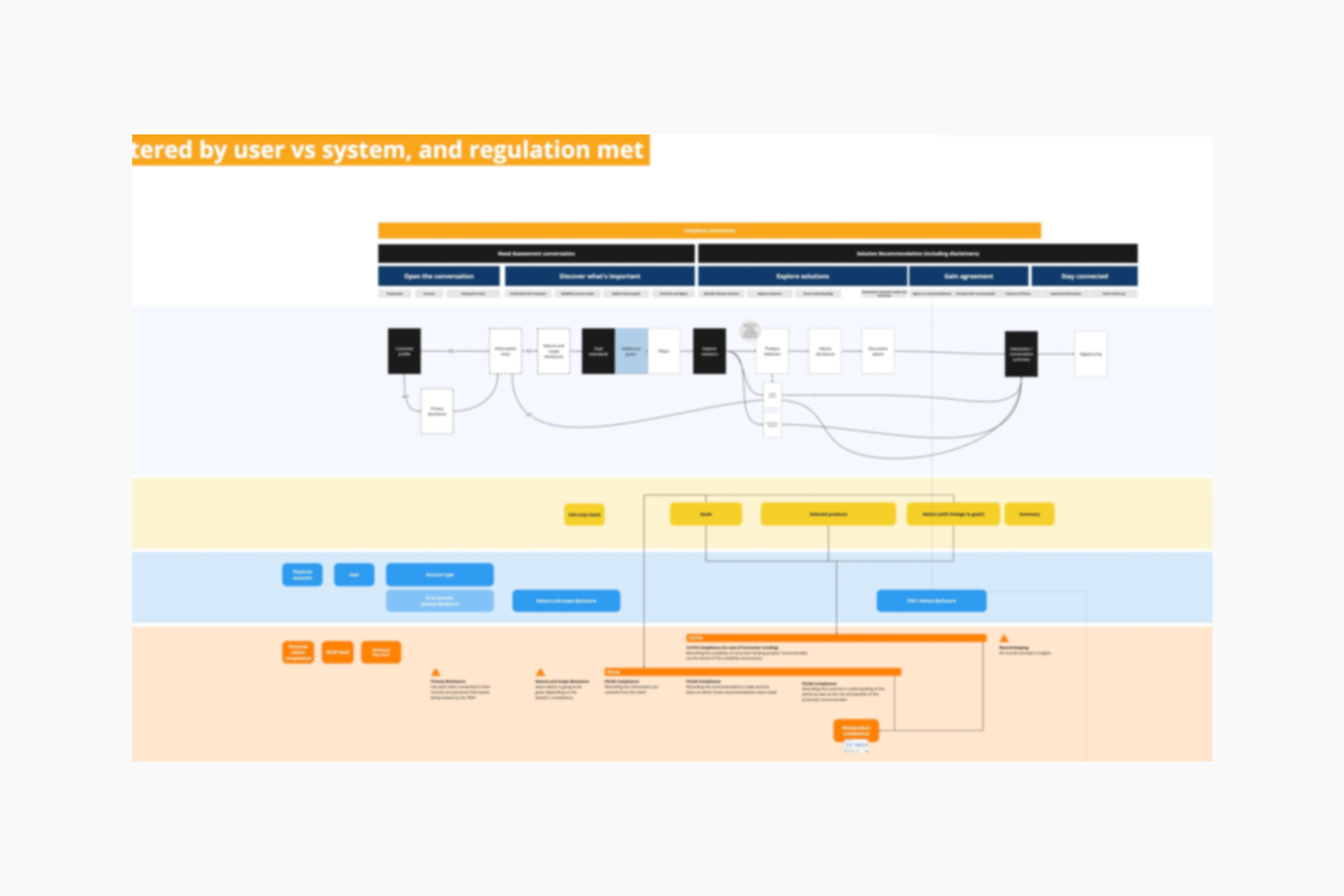
Advisory workflow concept showing how regulatory requirements were embedded across conversation stages — distinguishing what is entered by the adviser, automated by the system, and required for compliance across four banking segments.
Key activities
Developed four modular baseline scenarios showing how regulatory and customer information could be captured across different advisory contexts, with field-level logic covering dropdown structures, vulnerability flags, mandatory steps, and householding rules
Defined conversation frameworks aligning regulatory requirements with how advisers actually conduct in-person and phone-based meetings
Conducted usability testing with 15 frontline advisers within two weeks, delivering a recommendations report to guide business requirements
Stress-tested the framework with subject matter experts using complex private banking and institutional scenarios, confirming scalability without bespoke system logic
Worked across business, compliance, and analytics teams to confirm regulatory requirements, map customer data flows, and standardise advisory workflows
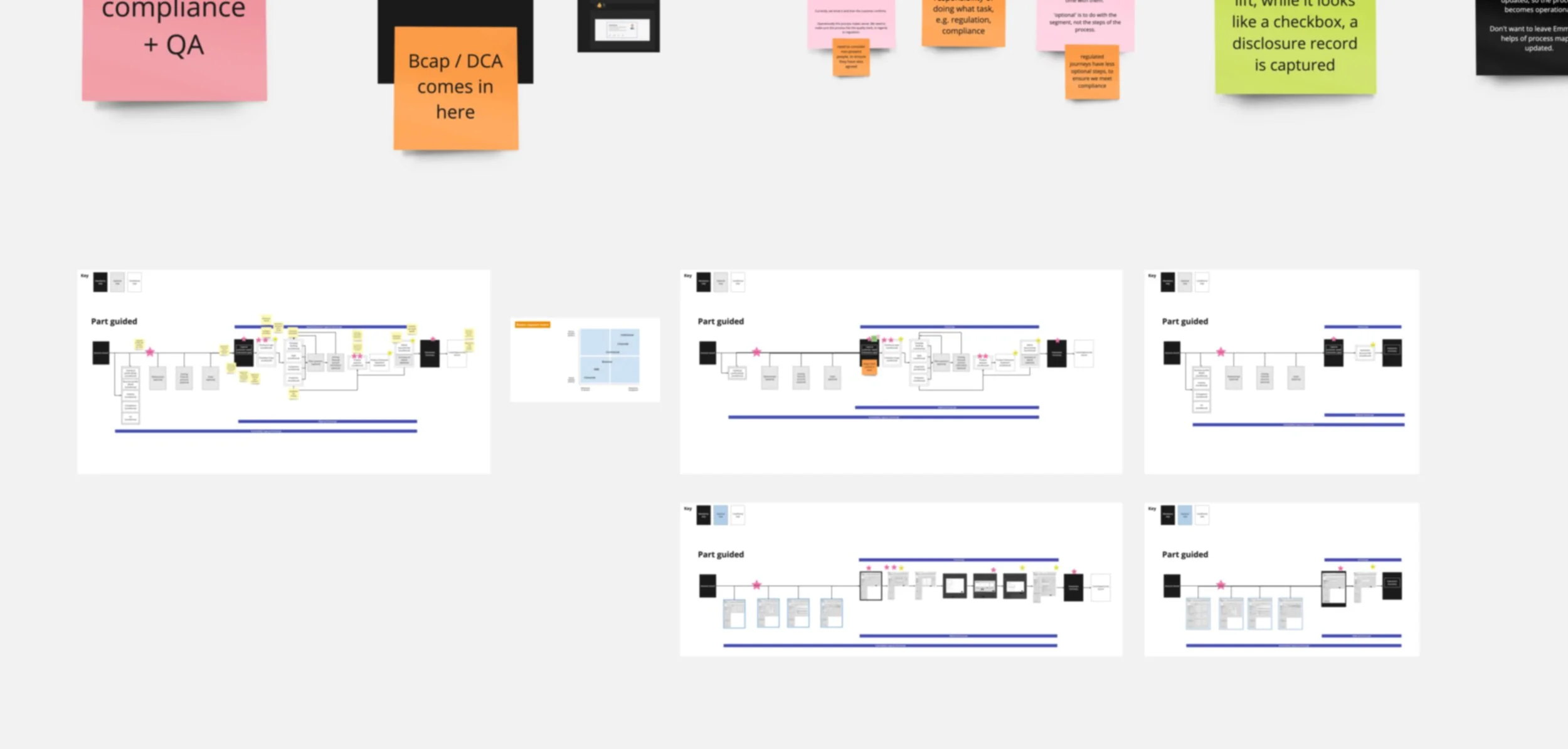
Usability testing synthesis showing design decisions, compliance considerations, and guided / part-guided scenarios across retail banking — used to validate assumptions and inform refinements to information hierarchy and data capture.
Contributions to key decisions
Recommended embedded design over compliance-first or segment-specific approaches, as the only strategy that balanced usability, consistency, and scalability across all four segments
Standardised regulatory capture where consistency was required while preserving adviser flexibility where variation was legitimate
Resolved the audit trail gap by embedding regulatory capture into conversation flow rather than relying on post-meeting data entry
Defined build-ready requirements using standard CRM components, reducing customisation complexity and long-term maintenance risk
Why this matters
Without clarity on where consistency was required versus where variation was acceptable, platform build risked embedding assumptions costly to unpick across four segments serving over a million customers. Surfacing these trade-offs before build gave teams a shared, evidence-based foundation for decisions affecting advisers, customers, and compliance teams simultaneously.
Outcomes and implications
Deliverables
Design report consolidating insights, decisions, and service-level guidance for advisory workflows, including design inputs defining requirements using standard CRM components and flagging complex areas
Conversation frameworks, workflow concepts, and wireframes illustrating regulatory and information capture across advisory contexts
Usability testing findings validating prototype assumptions and informing refinements to information hierarchy, data capture, and adviser interaction patterns

Usability testing report showing conversation framework validation, numbered scenarios, and recommendations — synthesised into design inputs for business and technical teams.
Outcomes and impact
Advisers could deliver and document compliant advice while maintaining natural customer relationships across interactions and four banking segments
Regulatory questions felt like understanding the customer better rather than administrative overhead, embedded into conversations rather than forcing screen-based interactions that disrupted rapport
Platform design used standard components, reducing customisation complexity while meeting regulatory requirements consistently across all four segments
The embedded compliance model became a shared source of truth across departments, replacing fragmented processes and informal workarounds
The framework reduced regulatory risk, accelerated staff onboarding, and laid the foundation for enterprise-wide scale starting with retail banking
Key learning
Treating compliance as the structure for customer conversations rather than a post-meeting checklist helped anchor a more consistent and compliant advisory model. The most important design decision was not how to capture information, but when and in what form, making regulatory requirements feel like natural conversation moments rather than administrative interruptions.